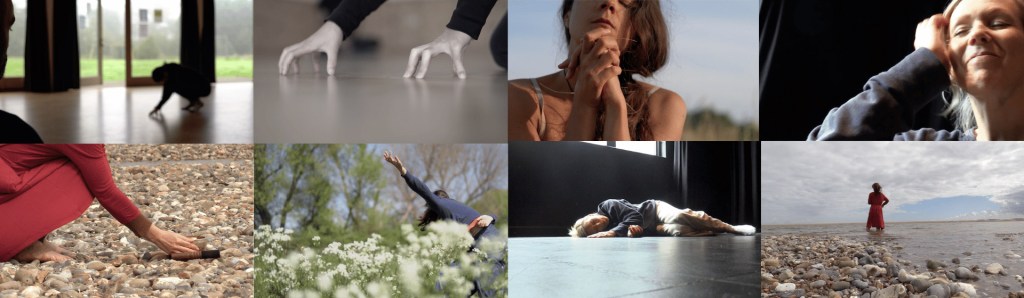
A Process of Somatic Filming explores the development of a somatic method of filming, where the filmmaker observes themselves as a sensing-moving self while engaging in a durational, site-specific practice with another mover. For the past six years, mover Claire Loussouarn and filmmaker Dominique Rivoal have returned monthly to Hackney Marshes, engaging in an ongoing dialogue with this dynamic, ever-changing landscape. Through an embodied approach to filming, this essay examines the interplay between the marshes, the mover, and the self, exploring movement as a form of relational inquiry. Additionally, it introduces camera-witnessing, an adaptation of the witnessing method from Authentic Movement, which cultivates sensory awareness, kinesthetic empathy, and dual awareness of both self and mover. By attending to movement, the filmmaker has deepened their sensitivity to different types of motion, intention, and relational dynamics. This essay shares these insights, inviting viewers into a nuanced exploration of movement, presence, and embodied filmmaking.
Video Transcript
Transcript: a process of somatic filming a film essay by Dominique Rivoal
Introduction:
My research is a movement-based experimental film practice that explores the shared dyadic and relational space between a filmmaker and a mover.This essay reveals the process behind developing a somatic method of filming, in which the filmmaker observes themselves as a sensing moving self, while engaging in a relational sited practice.For the last six years, mover Claire Loussouarn and myself, Dominique Rivoal, as a filmmaker, have been returning monthly to the site of Hackney Marshes to correspond with this dynamic, ever-changing space.Throughout this durational and iterative practice, I have experimented with various somatic methods of self-awareness to navigate being perceptually present with the marshes, the mover, and myself. One of my key methods for cultivating self-awareness is the practice of witnessing from Authentic Movement, a holistic movement practice initiated by Mary Stark Whitehouse and developed by Janet Adler.This practice cultivates sensory awareness of movement and kinesthetic empathy in dual awareness to self and mover.My research adapts this method into a technologically enhanced mode of witnessing, utilising the camera’s unique affordances and limitations to enable camera witnessing in this outdoor context.
Content:
Part one: Filming as a somatic practice
1.1 Relating with the Marshes
1.2 Relating with self
1.3 Relating with the mover
Part two: Relating with and through technology
2.1Equipment
2.2 Editing and presenting
Part three: Attending to camera movement
3.1 Four types of camera movement
3.2 The features of my ‘Moving Camera Witness’
3.3.Being moved
Concluding thoughts
Questions
How might somatic and dyadic methods inform ways of filming?
How can the camera operator navigate remaining with self, mover and context?
Part one: Filming as a somatic practice
Claire comes from a lineage of Amerta movement originally taught by Suprapto Suryodarmo and Sandra Reeve. This improvised, non-stylised movement practice is typically practiced outdoors, with the aim of cultivating a heightened environmental awareness.With our combined approach of Amerta and Authentic Movement, we began to work intuitively, without a plan or a script.This first day of filming in September 2018 marked the beginning of an ongoing investigation, during which we returned each month for six years to correspond with the marshes and each other. Initially, my goal was to explore the relational dynamics at play between the filmmaker and the mover, using a dyadic format to create a dialogue. However, as our dialogue progressed, I realised that the marshes were not merely a passive backdrop for our dancing. The marshes were an active, integral third partner in this collaboration.
1.1Relating with the Marshes
Recognising the embeddedness and the situatedness of the filmmaker-mover dyad marked a significant milestone in my practice. From then on, I began to enframe our dancing as part of nature rather than in front of it.
Hackney Marshes was once a lammas land where livestock grazed. In 1905, local residents gave up these grazing rights, dedicating this land for the purpose of an open space in perpetuity. This allowed Londoners free access to this ancient grassland.
Managed by a park authority, Leyton Marsh, the specific place where we film feels untouched, with most plants growing from the original seed banks in the soil.
To open myself to the more-than-human aspect of the marshes, I slow down and tune into my body’s innate receptivity, establishing ways to be affected by what I perceive.
I engage in reciprocal touch, peripheral vision, and actively listening to the marshes, focusing on receiving guidance from the marshes through sound and sensation.
Inspired by the insights of movement specialist Hubert Godard (2006), I also maintain an awareness of my own weight to enrich the reciprocal exchange between touching and being touched.
During the development of this work, I prepared myself with warm-up exercises using various practitioners’ scores, such as Mary Overlie’s’ ‘Walk and Stop’’ and Barbara Dilley’s ‘Five Eyes Practice’. These scores supported me to become more conscious of the way I move and perceive the marshes.
Eventually, it came to me that I was avoiding certain parts of the marshes that included houses to represent an idealised version devoid of human structure. With this insight, I was able to let go of a romanticised portrayal of the marshes towards a more genuine connection with them.
1.2 Relating with self
I become acutely aware of how tired I am from carrying the heavy camera. I lie down and tune inward. I close my eyes and listen to the enveloping sounds, sensing the impression that I make on the ground. The coolness of the earth and the soreness of my lower back become apparent.
As I rest my head more fully, I surrender my weight to the support of the land. In this moment of relating to self, I breathe with the camera resting on my front body.
Then a spontaneous transition occurs, I sense an energy coming from the ground. My boundary of self and earth dissipates. As Linda Hartley, teacher of Authentic Movement, writes, an energy to move fast, to explore, to be alive.
‘ We may have a direct experience of energy moving through and within the body when internal narrative and image-making cease, and the mind rests in the moment, present to the fullness of all that is.’ (Hartley, 2015)
When I sit up and open my eyes, I have no idea what is inside the frame—an arm, a leg? I am at a pre-verbal level, experiencing what Barbara Dilley calls ‘infant eyes’, seeing the world in motion from a still place, simply enjoying movement and shapes without labels.
1.3 Relating with the mover
Each month we work for about an hour. This duration enables us to sustain an openness and concentration that would be challenging to maintain for longer and in everyday life. We always work in silence and never give each other instruction to achieve a special effect, using orientation, proximity, movement and attention as an embodied form of communication.
We each write our personal reflection after a filming session. This diary and notes have been informing both the research and the editing process.
From the start, the mover mentioned how the presence of the camera witness enabled her to enter a movement exploration mode deeply, providing a safe container in a public space. However, Claire does not perform for the camera but considers its presence as just another element in the space.
Working together over an extended period has heightened my awareness of my framing habits. I prefer to match Claire’s level; filming her from the ground when she is lying down and standing up with her. However, I now find myself in the uncomfortable position of filming Claire from above.I fear that this perspective may perpetuate the ‘male gaze’, a concept coined by Laura Mulvey, which makes me hesitant to look at the female body from this angle.Anthropologist and filmmaker David MacDougall expresses how filmmakers are sometimes afraid to look, explaining that mental concepts can at times screen us from the world. [‘One has the impression that many filmmakers are afraid of looking’ (MacDougall, 2006 p8)]
This time I am able to sustain my gaze, witnessing both my fear and the invitations of the textures present in the frame. This leads me beneath the surface of meaning that I project onto the image.David MacDougall also notes that framings can reveal fluctuations in personal engagement and complicity with the subject.
In this moment, I am able to be in close relation with Claire because I feel particularly open to her. Prior to this filming session, we had both expressed a difficult communication, which restored the flow of relating.
The theory of ‘Mind Clearing’ (Berner, Whieldon), upon which some of this research is based, explains that a withheld communication between two people may create a distancing barrier.
Often, what is left unsaid accumulates to produce a density that may lead to a conscious or unconscious sabotage of the creative process.
As a way to further articulate moments of heightened connection between myself, the mover, and the marshes, I am employing the concept of ‘correspondence’ conceived by Anthropologist Tim Ingold as an alternative to intersubjectivity and described as a ‘togethering of the world’. (Ingold, 2017 p41)
The concept of correspondence suggests that to correspond is to move together in time and space as individual agents, in a parallel process in which, over time, a transformation can take place.
In this moment, I perceive the mutuality of this encounter and how Claire’s willingness to be seen invites my participating presence in her experience.Despite my own physical instability, I sense the directness of my attention, an unflinching witnessing in these frames.
Part two: Relating with and through technology
2.1 Equipment
After two years of meeting, the plan for creating a four-screen video installation began to take shape. And from then on, we incorporated an ambisonic microphone designed to capture immersive spherical audio alongside the camera’s mounted microphone. This addition significantly enhanced the quality of our audio, enabling me to continue filming solo, without the need for a sound recordist.
Depending on the conditions, I alternate between automatic and fully manual settings to control the light. On a day like this, when the light is constantly changing, I manually adjust the light, resting my finger on the aperture control.
Additional foley sound is added in post-production if needed. In this clip, I alternate between placing my eye against the viewfinder, which allows me to focus more intently on the mover, and looking at the camera through the LCD screen. This allows me to stay perceptually present to my surroundings.
In this instance, I use the zoom to come closer to the mover. In echoing her movement, I make visible a transfer of affect between us.
In preparation for the installation, I also began filming four perspectives of the marshes before Claire’s arrival, using this time to slow down, ground myself, and attune to the interplay between inner and outer landscapes.
In this clip, I am wearing a GoPro camera on my chest to document the filming process.
Recording!
From the start, I use long takes to anchor the human perspective of my dyadic approach in real-time and space. The long take holds space for movements to unfold while also simplifying the synchronisation of image and sound in post-production. The mounted microphone usefully captures nearby sound when it’s not too windy.
An important aspect of filming handheld, in the emergence of the moment, is to find stability while holding the extra weight of the camera. Sometimes, for short periods only, I suspend the camera from its strap, extended from my neck, allowing me to view the image through the LCD screen while also maintaining stability.
I also sit on the ground to be comfortable while holding the camera for extended periods, especially when filming close-ups.At other times, I simply stop looking through the camera and rest it against my centre, vaguely aiming it toward the mover.I have noticed that by allowing my weight to drop, I receive feedback from the ground on how to adjust my posture between earth and sky while accommodating the extra weight of the camera against my centre.
Working blindly with the camera rather than chasing images is an act of trust—one that invites chance and the emergence of the moment to shape the frame organically.
2.2 Editing and presenting
When presenting the installation, we wanted to recreate the sense of a wide, open space, allowing audiences to roam freely and, in a way, shape their own edit of the work. This sense of agency—the ability to move within the space—is central to a work that is relational at its core.
We edited the material together, drawing from our diaries and memories. It was important to weave together the filmmaker’s external gaze with the mover’s first-person experience, creating a fluid dialogue between the two.
This co-editing process required a degree of surrender as we navigated our differing intuition, muscle memories, and the reality of the footage itself. Yet in this exchange, something far richer than our individual perspectives emerged, deepening and enriching the project.The visual experience was enhanced by a surround audioscape, further revealing layers of connection between Claire’s movement and the sound of the marshes.
Part three: Attending to camera movement
As we returned to the marshes after the installation, we continued to value the process of encountering for its own sake, embracing its autotelic nature.
Through this ongoing practice, I was able to further refine my approach to filming as a somatic practice and begin to develop the distinct features of my camera movements.
3.1.Four types of camera movement
Vivian Sobchack identifies four kinds of movement in moving pictures, each of which resonates with different aspects of my somatic filming practice.
The first is movement within the frame—the motion of the subject or elements inside the image. More often than not, very little camera movement is needed to highlight a relationship between elements, allowing the interplay between the mover and the environment to unfold organically.
The second is movement between images, achieved through editing. This is a perceptual shift between the image we initially see and the reservoir of images stored in our minds. These invisible movements can be suggested through montage, activating the viewer’s associative mind, where meanings emerge through juxtaposition.
The third type is optical movement—the zoom or focus shift—which is the camera’s own motion. While optical movement is useful, it is invisible to the mover. In my dyadic approach, I prefer to use actual physical movement to reinforce the reciprocity between the camera operator and the mover.
The fourth and final type is camera movement, which Sobchack describes as ‘the bodily motion of the camera itself.’ This is where my practice of somatic awareness comes into play.
In my work, the camera’s recording of motion—both across its lens and through the movement of its operator—is supplemented by my own internal tracking. By internally sensing my movements, I investigate my evolving relationships with the mover and the environment.
The idea of becoming more conscious of the source of my movement is inspired by Mary Starks Whitehouse, the originator of Authentic Movement, who herself made a distinction between movements directed by the ego—’I am moving’—and movement arising from an unconscious source—’I am being moved.’
In observing my camera movement within somatic filming, I’ve identified several key features that shape my own practice.
3.2 The features of the ‘Moving Camera Witness’
1.Stillness
The first is stillness. The still position encompasses the subtle movement of breath, anchoring the subjective, living presence of the camera operator as an active dyadic partner.
2. Relational camera movement
Relational camera movement emerges in dialogue with the environment and others, responding dynamically to the motional world as it unfolds.
3. Intentional camera movement
Intentional camera movement is purposeful, deliberate action in which I consciously choose to move the camera. Vision asks a question, and movement offers a resolution.My movement opens new ways of relating and interpreting the unfolding phenomena. This often involves small, exploratory optical shifts in search of a frame before settling into stillness and presence.When I move with the camera, I am not as free as the dancer. It is as if I am preciously carrying my eyes and ears in my hands.
In dyadic practice, it’s important for me to be clear about my movement. This helps the mover to subtly orient themselves toward the camera.
4. Performative camera movement
I have also learned to recognize when my relational movement becomes performative—when I add volume to my camera work as an expression of my own inner world. In these moments, I may be echoing the mover yet also layering additional movement in a way that is both relational and performative.
As Tim Ingold notes, movement is both a perception of the world and an expression of it. (Ingold 2000)
Sometimes, I only notice my movement in retrospect, realizing that my hand has moved on its own accord, responding spontaneously to my desire to see, bypassing my conscious tracking.
5. Being moved
In this moment, I was being moved.
3.3.Being moved
Returning to the everyday movement of the marshes over an extended period has also heightened my awareness of how I am being moved by different scales of movement—from vast disruptions like a global pandemic to the seasonal cycles that inform the way we move.
Interestingly, I have also observed how the marshes themselves use human mobility to extend beyond their own boundaries—into the digital sphere through filmed images, their hitchhiker seeds cling to our clothes, dispersing into the physical world, as we unknowingly carry them to new locations.
This interplay between landscape, movement, and correspondences further deepens my understanding of being moved—not only as a physical or emotional state but as an ongoing process of entanglement and exchange.
One of the most important insights I’ve gained in applying the method of witnessing to my camera work is recognising the power of observing my impulses to move, to adjust, to seek a better angle—without immediately acting on these impulses.
Instead, I remain still, holding the inner tension of ‘staying with’…without judgment, in compassion, until my movement arises organically—invited by the event itself.
In these moments, I am not merely recording but actively participating, moving, and resonating with the world.
Movement enables connection… Connection enables movement…
In my practice, I’ve come to understand that I want to use movement sparingly, to signify both to myself and to whom or what I am filming that I am moved, that a cohesive moment of correspondence is unfolding.
Concluding Thoughts
The features of camera movement that I’ve highlighted here resist fixed categorisations. Yet, they reveal how a camera can be fully integrated within a somatic practice to deepen an investigation of movement.
The camera offers the possibility of choice both in the moment—by witnessing unfolding decisions in real time—and retrospectively, when reviewing the footage that preserves the correlation between the movement in front and the movement of its operator.
As a filmmaker, my practice had always been intuitive. However, by attuning to soma and tracking my own movement, I have become more considerate in my actions and I’ve come to a deeper realisation.
All movements are ultimately relational.
In witnessing my own capacity to be moved, I recognise the importance of finding stability both physically and relationally.
This ongoing dialogue between seeing and being seen, between moving and being moved, lies at the heart of my dyadic practice.
However, learning to suspend judgment, remain compassionate, and stay centered is a lifelong practice.
with
Mover Claire Loussouarn
Filmmaker Dominique Rivoal
Installtion soundscape: Cesar Salazar Portillo
Special thanks to
My supervisors: Vida Midgelow, Stefanie Sachsenmaier, Vesna Lukic
My friends:Stephen Hopkins, Katsura Isobe, Sharon Reshef Armony Daphne Julia Dahrendorf, Agnès Perelmuter
Middlesex University
Bibliography
Adler, J 1999, ‘Who is the Witness? A Description of Authentic Movement’, in P Pallaro, Philadelphia, Jessica Kingsley Publishers
Di Fazio, C. (2015) ‘Phenomenology of Movement’, Eikasia: Revista de Filosofía, 66, pp. 233–252. Available at: https://old.revistadefilosofia.org/66-07.pdf (Accessed: 24 March 2025).
Dilley, B This Very Moment teaching thinking dancing Digital Edition: 2020. Contact Editions, Northampton, MA ISBN 978-0-937645-11-6 (PDF book)
Goldhahn, E. (2020). Being seen digitally: exploring macro and micro perspectives.
Body, Movement and Dance in Psychotherapy, 16(1), 87–100. https://doi.org/10.1080/17432979.2020.1803962
Godard, H. (2006) ‘Phenomenological space: ‘I’m in the space and the space is in me’’, interview with Caryn McHose, Contact Quarterly, 31(2), pp. 32–38.
Hartley, L. (1995) Wisdom of the body moving: An introduction to Body-Mind Centering. Berkeley, CA: North Atlantic Books.
Hartley, L. (2015) ‘Choice, surrender and transitions in Authentic Movement’, Journal of Dance & Somatic Practices, 7(2), pp. 299–312.
Ingold, T. (2017) Correspondences. Aberdeen: University of Aberdeen.
Ingold, T. (2000) The perception of the environment: essays on livelihood, dwelling and skill. London: Routledge.
MacDougall, D. (2006) The corporeal image: Film, ethnography, and the senses. Princeton, NJ: Princeton University Press.
Mulvey, L. (1989) Visual and other pleasures. London: Palgrave Macmillan.
Overlie, M. (2016) Standing in space. Billings, Montana: Fallon Press.
Pallaro, P., 2007. Authentic Movement: Moving the Body, Moving the Self, Being Moved: A Collection of Essays – Volume Two. Jessica Kingsley Publishers.
Reeve, S. (2013) Body and performance. Axminster: Triarchy Press.
Sobchack, V. (1992) The address of the eye: A phenomenology of film experience. Princeton, NJ: Princeton University Press.
Sobchack, V. (1982) ‘Toward inhabited space: The semiotic structure of camera movement in the cinema’, Semiotica, 40(3–4), pp. 317–335.
Whieldon, A. (2015) Mind clearing: The key to mindfulness mastery. London: Jessica Kingsley Publishers.
A relational dyadic approach to filming explores the development of an experimental filming practice that integrates somatic movement practice with a relational dyadic process called the ‘relating dyad’ (Berner) to investigate the mutuality of the encounter between the filmmaker-dancer dyad. The ‘relating dyad’ (Berner) is a self-enquiry process originating from personal development practices, expanded here through movement, somatic self-awareness, and witnessing; inspired by Authentic Movement (Whitehouse, Adler) to deepen presence for both filmmaker and mover.This adaptation was tested through filmed dyads, workshops, and participatory experiments, culminating in Tell Me Where You Are, a co-created film with Helen Kindred.By introducing shared authorship of the camera, the research shifts the dynamic from subject and observer to co-creators. Workshops at conferences such as the Dance and Somatic Practices Conference (Coventry, 2019) and the Sixth Colloquium on Artistic Research in Performing Arts (Helsinki) played a key role in refining this approach within artistic research contexts.Findings highlight the camera’s potential not just as a recording device, but as a tool for deepening presence and relational awareness. The study proposes ‘filming as a dyadic practice ’ as an emerging practice that prioritises interaction, co-creation, and embodiment over conventional representation.
Video Transcript
Content
introduction
02:46 The dyad
Dyadic methods
04:38 The enlightenment intensive
07:11 The ‘relating dyad”
08:58 My first filmed dyad
10:39 Movement
13:23 workshops
14:26 tell me where you are?
28:33 Concluding thoughts
1.Introduction
My research centres on developing an experimental filming practice situated at the intersection of filmic dyadic and somatic practices, with the aim of developing a somatic filming method that unfolds through a series of dyadic encounters between the filmmaker and the somatic mover, sharing cameras in a co-creative process.
A central goal of my practice is to use the camera as a tool to cultivate a conscious awareness of movement through an engaged relationship with myself, the mover and the broader context.
Jennifer Nikolai, who explored a dyadic approach to improvisation, emphasises how cameras handheld dancers enable both ‘an immediate and retrospective examination of movement’ (Nikolai 2016).
Building on this, my practice combines filming with somatic methods of self-awareness, such as internally tracking one’s own movement while operating the camera. My approach facilitates what Ben Spatz refers to as ‘a video way of thinking’ (Spatz 2018 ), offering an alternative method for reflecting in action on embodiment and relational dynamics.
Text on screen: Adesola Akinleye and Dominique Rivoal improvisation in ‘Window into worlds’ an interactive exhibition by Ben Spatz 2019
While my research primarily focuses on the immediate process of using the camera as a tool for embodied thinking and presence, the recorded material also serves as a resource for retrospective reflection on the relational dynamics between two movers.
In 2021, I collaborated with dancer Helen Kindred to create ‘Tell me where you are?’ a film inspired by the ‘relating dyad’, a process rooted in personal development practices. This video essay traces the journey of adapting this dyad process to integrate movement, somatic methods of self-awareness, and the use of cameras to explore the relational dynamics between two movers. The film was made over an intensive period of three days , with four filmed dyads per day, echoing the structure of an actual retreat
2. The dyad
A dyad is something that consists of two elements or parts. For example, the mother-child dyad. A therapist-client relationship. A musician and their score. An artist and their tools. A dyad is always situated within broader geographical, historical, cultural and social contexts that further define it. In an educational setting, for example, the ‘Think Pair Share’ method facilitates developing one’s own voice through discussion with a partner before engaging with the wider perspective of a group.
Text on screen: ‘Look Beyond Borders’ A video by Amnesty International 2016
A dyadic approach is exemplified in an Amnesty International video inspired by Arthur Aaron’s research, which posits that four minutes of eye contact can bring people closer together. The video fosters a shared human experience between Refugees and Europeans, showcasing the transformative power of relational attention to bridge cultural divides.
In my research, I explore filming as a dyadic process involving two elements on either side of the camera; the camera person who actively frames the visible, and the mover who, as Dance scholar Sondra Fraleigh describes, ‘lends themselves for the sight of others’.
Text on screen: ‘I lend myself to the sight of another when I perform’ (Fraleigh 2019)
3. Dyadic methods
To explore the motional and relational dynamics between a filmmaker and a somatic mover. I combine the two distinct dyadic methods. These are the mover-witness dyad and the ‘relating dyad’.
The mover-witness dyad originates from Authentic Movement, a practice initially created by Mary Stark Whitehouse and later developed by Janet Adler. In its basic form, this practice involves the dyad between ‘a mover who takes on the role of being seen, and a witness who takes on the role of seeing’ (Adler 2022).
From the discipline of Authentic Movement, I incorporate witnessing as an overarching method. Witnessing, as developed by Adler, is a practice aimed at developing the ability to see others more clearly; through a process of discernment that distinguishes judgement from direct observation, enabling the witness to move beyond personal projections, interpretation and evaluation of others. It involves attentively tracking one’s movement, sensation, emotion, and imagery in response to the mover as a catalyst.
The second method is the ‘relating dyad’. This method was originally developed in California by Charles and Eva Berner during the 60s. It combines Zen self-inquiry meditation with an interpersonal communication process. It is commonly practised in an enlightenment Intensive, a three-day retreat focussed on personal growth. The experimental film Tell Me Where You Are ? was created blending these two dyadic models both aimed at grasping a direct experience of the world.
However, this essay focuses primarily on the ‘relating dyad’ and how I have adapted this method to incorporate movement, cameras and the practice of witnessing; which together shaped the creation of this film.
4. The Enlightenment Intensive
The enlightenment intensive is Berner’s most renowned contribution to the field of personal development practices. These retreats held globally, guide participants in exploring existential questions known as Koans in pairs, with the intention of moving beyond the rational mind to achieve what Berner describes as ‘a direct experience of the self’.During this retreat, the participants practise the ‘relating dyad’ intensively over 12-hour days for three consecutive days, focusing on the same question throughout. In combining Zen self-inquiry, traditionally practised by monks in solitude with the interpersonal process of the dyad. Eva and Charles Berner suggest that face-to-face inquiry may be more effective in achieving what they refer to as enlightenment than a solitary practice.
Text on screen: Tell me where you are?
I personally came across the enlightenment intensive through my training in Mind clearing, a one-to-one therapeutic process initiated by Berner with the purpose of helping individuals to improve their ability to communicate. Over time, the basic structure of the ‘relating dyad’ has been applied across many different contexts, such as non-violent communication and the online Global Dyad Meditation project that enables pairs to practise the dyad meditation over the pandemic and beyond.
5. The ‘relating dyad’
The ‘relating dyad’ is a self-contained meditative inquiry process practised in pairs. Partners swap roles every five minutes, taking turns to respond to a set instruction within a 40-minute dyad cycle.
In expressing the content of their consciousness freely, without interruption, they are developing the courage to express ‘truths that are not usually shared’ (Fausset 2017). Through each iteration of the same question, participants can shed superficial layers and dive deeper into their inquiry. As they are met with unconditional, non-judgmental support; a sense of self, free from preconceived ideas, may begin to emerge.
The structure of the dyad allows the partner to figure something out without interruption and to witness the emergence of something new. According to Berner, when a thought is expressed, received, and understood, its unconscious potency is liberated and no longer abstract. The willingness to be seen and heard within the dyad fosters a subtle sense of accountability—to stay present and listen actively.
At its core, the ‘relating dyad’ thrives on reciprocal openness. When one person takes the step to reveal themselves, it naturally invites the other to do the same.
6. My first filmed dyad
This is my first filmed dyad, recorded on the return journey from an Enlightenment Intensive in 2016. I asked my traveling companion for permission to film one last dyad before we readjusted to city life. ‘Tell me who you are’ The mutual presence draws me in, forming a loop in consciousness in which we mirror each other, in reference to our own uniqueness and facings and the ever-changing context.
The bracketing of time and space in a dyad
fosters a commitment to an encounter,
inviting a direct way of knowing between seeing and being seen.
Could the mutuality of this ephemeral dance between us
be revealed in 24 frames per second?
As we orient toward each other, for me, it’s not about who I am,
but who I am with you.
I recall, on the third day of an intense verbal exchange, standing up before my partner and declaring, ‘This is me’. The act of standing to reveal myself involved reaching out—a movement towards connection. This movement was key to granting me the agency to be and act from what felt like a genuine place. When my partner responded by standing up in return, a reciprocal connection emerged, and I began to germinate the idea of using movement within the dyad as an alternative mode of relating.The impact of this retreat was so profound that I felt compelled to share it with the world. This inspired the idea of filming the ‘relating dyad’, not as a documentary, but from within the dyad itself as an active participant who is simultaneously filming and undertaking the transformative power of this process.
These early ideas to explore movement and to use the camera within the dyad—were the seed of my research idea. From these initial impulses, everything else unfolded.
My first step was to integrate conscious movement into the ‘relating dyad’, not for the sake of movement itself, but to cultivate an awareness of movement within the relational dynamics of the dyad, as inspired by the Discipline of Authentic Movement.
7. Movement
Text on screen:
‘Movement is the very means from which organisms can enter in relationship with each other and the world’ (Hubert Godard, 1995).
‘Movement is a way of thinking in which the body itself participates’ (Maxine Sheets-Johnstone 1981).
‘Movement gives us our first sense of agency’ (Maxine Sheets-Johnstone 1999).
8. workshops
The ‘relating dyad’ was originally developed by Berner as a practice—a do-it-yourself method for individuals who could not afford one-to-one therapy. making the Peer Somatic Gathering in 2018 an ideal setting to test this process. In a two-hour workshop, I introduced my idea to the somatic therapists, dancers, and educators that made up this peer group, asking them to explore the notion of the arising self through movement and language. As an added instruction, I invited the listening partner to adopt a witnessing approach, emphasising non-judgmental support, but also to pay attention to their own felt-sense while listening, in dual awareness to self and other.
The dyadic format is already commonly used within somatic settings, and practitioners are well-versed in employing language as a reflective and communicative tool to articulate and make sense of embodied experience. However, I wondered if the directness of the question and iterative structure of the ‘relating dyad’ could add a new dimension to this exploration, deepening and enriching the relational field.
Some found that the repetition of the same question allowed them to delve deeper into it, while others found creative ways to navigate the dyadic process on their own terms, maintaining continuous movement through the space.
Building on the idea that movement and a method of witnessing could enrich the ‘relating dyad’ process, I experimented with introducing the camera into this framework. The relational exchange and the role-swapping inherent to the ‘relating dyad’ led me to ask: What happens when the filmmaker shares the same level of visibility, presence, and vulnerability as the dancer? And conversely, what happens when the dancer takes hold of the camera, stepping into the role of the filmmaker?
This camera-assisted format was tested at the Dance and Somatic Practices Conference in Coventry (2019) and the Sixth Colloquium on Artistic Research in Performing Arts in Helsinki . These workshops were structured to ensure participants filmed only the final dyad, allowing time to experience the role-swapping dynamic and to build rapport before introducing the camera.
Participants were encouraged to orient the camera loosely toward the mover; at once supporting their partner while also taking a video recording. Before filming each other, the partners swapped phones in an innovative approach that allowed the filmmaker to use the mover’s own device. This ensured that the resulting portrait remained in the mover’s possession, reinforcing their sense of ownership over their representation. Additionally, this method enhanced the ethical integrity of the process, particularly by ensuring control and safeguarding of personal data.
Video: Coventry Video composite extract.
As I observed the workshop participants and reviewed the recordings, I became interested in the choices made by the camera operator in navigating both filming and witnessing their partners.
I noticed how the affordances of the camera affected the relationality at play within the process. For example, zooming in and out, an internal camera movement, remains invisible to the mover. This poses a challenge for the dyadic process, as this invisible camera movement is unreadable to the mover, disrupting the mutual relational dynamics between the pair.
Video: Helsinki Video composite extract.
In the following discussion i gathered the following feedback:
•I met a stranger in a unique way and shared something with them.
•We are trying to find a way to be together and create something into being together.
•Both become vulnerable. Equal experience, of course. Supporting each other.
•Ethically problematic using a therapeutic process in a conference.
•It’s not about the dancer creating content for the filmmaker. It’s about cohabiting space.
•One of the research outcomes might be to facilitate this workshop.
•How about instead of ‘Tell me who you are’, ‘Show me who you are?’
For my next presentation, which took place in the context of artistic research, I designed the question to progress from: Tell me who you are/ show me who you are/ sense who you are, with the idea that this prompt would facilitate a shift from an intersubjective space to an inter corporeal space emphasising physical, sensory, and embodied interaction.
In the closing discussion, I gathered the following feedback:
•Am I performing myself or being myself?
•Connection to her bodily movement with my body movement.
•The last interaction became more important because it is filmed.
•The camera could be in the hands of the mover to film the witnessing.
•Noticing you witness attention, move towards another person in the room and how this affects the responder.
•The sense of self is always in relation. Instead of the camera being focused on the performer, the camera could be placed on the in-between.
•Showing becomes a way of saying the unsayable.
Vocalise the option that you can stop at any time.
•Having the video portrayed on my phone felt like a gift.
The feedback raised key questions for my research, such as whether someone can operate a camera while remaining fully present with their partner, and the challenge of simply being, rather than performing. The presence of the camera often compels individuals to alter their behavior under its gaze. However, in my experience, the camera also acts as a catalyst, enabling the mover to commit more fully to the process of being present. Further reflections highlighted the value of connection over aesthetics, serving as a reminder that in this practice, the process holds greater significance than the final product. This shift in emphasis aligns with the ethos of somatic practices, which are autotelic at their core, valuing the opportunity to deepen awareness as the main reward, independent of any external outcomes.
One participant observed how their partner’s act of looking away affected them, underlying the critical role of mutual presence within this dyadic exchange.
In Berner’s ‘relating dyad’, maintaining eye contact is encouraged to foster a sense of intimacy. However, my research expands this concept by introducing the witnessing presence, as something that encompasses the whole body, not just the eyes. In a dyad, the eyes may naturally be drawn away by something in the surrounding space that attracts attention. This shift does not necessarily diminish the connection but allows the broader context to inform the dyadic exchange.What may appear as a withdrawal from contact can in fact create more space within the dyad, enabling the mover to step in both relationally and physically.
Furthermore, Ellen Kilsgaard, a dancer and movement researcher, observes that the ability to remain with feelings of disconnection, whether it’s shyness or a sense of being unmet without avoiding it or masking it, lays the groundwork for developing genuine connection. She writes:
‘Becoming available to the relational space means to offer oneself into a meeting place and simultaneously become receptive to the other’. (Kilsgaard, 2009)
The role swapping dynamic of the ‘relating dyad’ provides an opportunity to practice each step separately, offering oneself into the mediated space and holding the frame in receptivity for the mover.
This iterative back-and-forth process between opening and receiving gradually cultivates a field of mutual vulnerability, allowing the conditions to emerge for embodying both states, fluidly, at the same time.
In a mediated encounter, the camera occupies the middle space at once, recording the visible and the presence of its beholder within the surrounding audio environment. Framing, selecting and emphasising part of the whole is an expressive act, but the mover also shapes how they are seen by the camera at times, taking an active role in self-presenting.
These Workshops provided a valuable opportunity to share my evolving practice, gather insightful feedback and refine my methods. While this process fosters a profound connection and insight, the prompt ‘tell me who you are?’ may feel too personal in a public workshop setting, raising important considerations around privacy and consent.
Despite these challenges, the ‘relating dyad’ remains a powerful method for exploring the mutuality of the encounter within embodied filmmaking.
To address these concerns, future workshops could introduce different questions, tailored to accommodate the participants’ varying levels of somatic engagement or familiarity with the filming process.
9. Tell me where you are?
Following from the workshop phase, I then began working one-on-one with different dyad partners using the new prompt: Tell me where you are? Although this instruction was not part of Berner’s original framework, it felt profoundly relevant to the challenges and context of our present times.
Helen ‘s voice : and then just noticing the really subtle movements. I remember when I was first introduced to Steve Paxton, “small dance”, I didn’t understand it. I was too young and immature and couldn’t see why it was a dance at all. and it comes to me now. as something quite beautiful. just noticing those small sensations, just little or the little micro dances inside of you.
I can feel it in the muscles here? in my eyes, flickering. This little, little dance is happening here at my fingertips. In my breath. Every breath initiates another. Space for that small dance I am noticing my weight
Text on screen: The camera operator is also engaged in a parallel ‘Small dance’ (Steve Paxton, 1970).
I am noticing where my weight is. My whole body. There’s a connection with the earth and that’s through my feet. But that’s not where my weight is. not only where my weight is.
Test on Screen: Holding the camera as an object without looking through it helps me remain in physical presence with the mover.
When this imagery of thinking of connected to the earth and nourished by the earth, and I feel in this moment that my sole of my feet spreading and and the soles of my feet spread, and as they spread that really open this connection, that they’re really open to receiving nourishment, to receive in energy, to to being connected to that sense of my body is the environment. I’m not I’m not standing on the floor. I really feel. I’m open. It’s the sole of my feet opening. And that offers a route into the body. Earth / conversation, I guess.
Text on Screen: “Seeing with the camera instead of through it”. (Sociologist Monika Buscher, 2005)
Vesna’ voice : tell me where you are ?
Again I repeat the same questions ?
And it just had a thought that maybe the character did some paper. Looks sort of like something between our faces, you know?
10. Concluding thoughts
This concluded my research phase in preparation of making the film of ‘tell me where you are’ with Helen kindred.
Using the dyad as a method has led me to consider filming as a dyadic practice—one that involves two elements on either side of the lens. The camera acts as a membrane that intertwines the visibility of the mover with the corporeal presence of its operator.
My work sought to bring more visibility to the camera operator, which despite their attention and presence, often remain invisible, using the camera as if it were a meeting place, an extension of the self and a reception of the other. The role-swapping dynamic of the ‘relating dyad’ has helped to shift the focus away from traditional hierarchies, where the dancer is typically the subject and the filmmaker the observer.
Instead, it fosters a collaborative, shared experience. This approach reveals agency on both sides of the camera: the agency of developing one’s own perception through framing and the agency of being seen through self-framing and orientation towards the camera.
By attending to my own soma while operating the camera, I engage my whole embodied self to create compassionate framings that move away from the ocularcentric tendencies of the medium.
The dyadic framework supported by somatic methods of self-awareness has enabled me to cultivate a heightened sensitivity to relational dynamics, allowing me to hold multiple perspectives at once. This has in turn contributed to the development of the key features of the moving camera witness, which I explore in a separate video essay.
Through this research, and by using the camera as a lens-based form of vision, I have come to understand:
- Filming as a dyadic practice
- The camera as a tool for deepening presence,
- The dyad as a dynamic interplay of agency and vulnerability
- Being seen and heard as an act of empowerment
- Movement toward and away as equal expressions of relational dynamics
- Movement as a principle for connection
- Editing as a process of recontextualization
- The question ‘Tell me where you are?’ as a profound reminder of our interdependence with others, space, and time.
Need the credits
In the dyad,
when each partner remains centered in their weighted self,
and give their attention to one another,
a bi-directional loop is created,
generating a momentum in which
emerging selves are co-composed in dialogue;
led moment by moment
beyond a limited sense of self,
as they are stepping into dancing,
In the presence of each other,
I experience humanity
How long can i remain with you
And you with me
before the boundaries slowly ceased to exist
And reveal glimpse of humanity
So i can feel how
Giving you my attention
and receiving your attention
Before I enter the realm
The dyad created a field of mutual inclusion
Consciousness
When attention extend
Include
when each partner giving each other their prse
a bi-directional loop is created,
generating a momentum in which emerging selves are co-composed
led moment by moment beyond a limited sense of self,
as they are stepping into dancing,
The encounter becomes palpable.
their presence
Bibliography
Adler, J. (2002) Offering from the Conscious Body: The Discipline of Authentic Movement.
New York: Simon and Schuster.
Amnesty International (2016) ‘Look Beyond Borders – 4 minutes experiment’.
Ben Spatz (2018) ‘The video way of thinking’, South African Theatre Journal
Büscher, M. (2005) ‘Social life under the microscope’, Sociological Research Online, 10(1).
Fausset, U. (2017) Ordinary Truth.
Fraleigh, 2020. “A Phenomenology of Being Seen.” In Back to the Dance Itself:
Phenomenologies of the Body in Performance, 89–101. Springer.
Kilsgaard, Ellen. 2009. “Experiments in a Relational Field-1.
Newton, A. (1996) ‘The functional approach: basic concepts in the work of Hubert Godard’
Nikolai, Jennifer. 2016. “The Camera-Dancer: A Dyadic Approach to Improvisation.
The International Journal of Screendance 6.
Sheets-Johnstone, Maxine. 1999. The Primacy of Movement. Amsterdam: John Benjamins Publishing.
Whieldon, A. (2016). Mind Clearing: The Key to Mindfulness Mastery. Jessica Kingsley Publishers.
Intro This video essay explores the development of an experimental filming practice that integrates somatic movement practice with a relational dyadic process called the ‘relating dyad’ (Berner) to investigate the mutuality of the encounter between the filmmaker-dancer dyad.
The ‘relating dyad’ (Berner) is a self- enquiry process originating from personal development practices, expanded here through movement, somatic self-awareness, and witnessing; inspired by Authentic Movement (Whitehouse, Adler) to deepen presence for both filmmaker and mover.
This adaptation was tested through filmed dyads, workshops, and participatory experiments, culminating in Tell Me Where You Are, a co-created film with Helen Kindred.
By introducing shared authorship of the camera, the research shifts the dynamic from subject and observer to co-creators. Workshops at conferences such as the Dance and Somatic Practices Conference (Coventry, 2019) and the Sixth Colloquium on Artistic Research in Performing Arts (Helsinki) played a key role in refining this approach within artistic research contexts.
Findings highlight the camera’s potential not just as a recording device, but as a tool for deepening presence and relational awareness. The study proposes ‘filming as a dyadic practice ’ as an emerging practice that prioritizes interaction, co-creation, and embodiment over conventional representation.
Watch the film: Tell Me Where You Are
The Moving Camera-Witness explores how the act of filming can become a somatic and relational practice of witnessing. Drawing from the Discipline of Authentic Movement and informed by interviews with practitioner Eila Goldhahn, the video essay unfolds across six chapters, each offering a layered reflection on witnessing as a transformative act—both in movement and through the lens.
Beginning with a meditation on the meaning of witnessing, the essay situates this practice within historical and therapeutic contexts, invoking thinkers such as Carl Rogers, Ram Dass, and David Abram. It then traces the origins of Authentic Movement, focusing on the dyadic relationship between mover and witness, where presence, non-judgment, and embodied attention create a container for deep awareness.
In conversation with Goldhahn, the essay examines the ethical and aesthetic dimensions of camera witnessing—a practice that extends the principles of Authentic Movement into visual and cinematic forms. Goldhahn shares insights into the importance of physical positioning, restraint, and care when filming movement, highlighting the subtle ethics of witnessing with a camera.In the fourth chapter, Rivoal offers a personal insight into her own evolving practice as a moving camera witness. Departing from a static witnessing position, she explores how the camera can become an extension of the mover’s body—responsive, attuned, and alive to the relational field. This participatory approach reframes filming as an embodied dialogue, in which the camera operator is both witnessing and being moved.The essay then moves outdoors to Hackney Marshes, where Rivoal’s long-term collaboration with Claire Loussouarn expanded the practice into a site-responsive method of filming. In this durational work, the Marshes themselves emerge as a third partner in the dyad, offering environmental resonance and grounding. The camera becomes not just an observer, but a conduit of connection—between people, place, and motion.The Moving Camera-Witness concludes by proposing a redefinition of witnessing in screendance—not merely as visual observation, but as a full-bodied, ethical, and participatory engagement. It offers a method where framing becomes an act of care, and movement becomes a shared process of becoming-with the world.
Video transcript
The moving camera-witness
A video essay by Dominique Rivoal
1.To witness
2.Authentic movement
3.Camera witnessing interview with Eila Goldhahn
4. An insight
5. Witnessing outdoors.
6.Concluding thoughts
- To Witness (Cambridge Dictionary, 2021, online)
- To see something happen, such as an accident or crime.
- To sign an official document.
- To testify in court as a witness.
- To bear witness – acknowledge the significance of an event or experience
• ‘non-judgmental and empathetic support to facilitate healing’ (Carl Rogers 1957)
•‘The witness is the awareness of your own thoughts, feelings, and emotions’ (Ram Dass 1971)
‘A witness validates events, giving them public recognition and acceptance’ (John Weir 2008)
•‘not only to see but acknowledge how the experience has changed you’ (David Abram, 1996)
•A freshly participatory, empathic, and engaged way of experiencing a partner’s movement (Lizzi Le Quesne 2015)
2.Authentic movement
Authentic Movement originates with Mary Starks Whitehouse, a pioneer in dance movement therapy inspired by Jungian psychology. Whitehouse moved beyond traditional dance aesthetics, inviting her students to close their eyes and explore movement from within, focusing on the sensorial experience of the movement itself, instead of its external appearance.
Whitehouse called this Movement in Depth– a way of using movement as a bridge to self-awareness and transformation. Here, the body becomes a vehicle for accessing and expressing inner states-without words.
She began to draw a distinction between movement driven by conscious intention- ‘I am moving’- and movement that arises organically, from a deeper, unconscious place – ‘I am being moved.’
This subtle shift-from doing to being-lies at the root of her process.
Whitehouse’s legacy was later developed by Janet Adler into what is now known as the Discipline of Authentic Movement. At its core, it’s a dyadic practice:
‘a mover takes on the role of being seen, and a witness takes on the role of seeing.(Adler, 2022: p89)
Adler formalised the role of the witness into a refined discipline – one that cultivates deep presence, relationality, and over time, enhances the mover’s capacity to self-witness.
Today, Authentic Movement has grown into three primary branches: the artistic-where creative expression is explored; the therapeutic-supporting psychological integration; and the mystical-engaging movement as a path to spiritual insight.
Sound: A bell rings
The mover closes their eyes… and begins to look within.She may follow an impulse to move – or remain in stillness – while developing her internal witness: the capacity to stay present with her own movement.
Tuning inward, she may begin to interocept; sensing the shape of her body. observing her breath, and noticing the subtle movements occurring within.
What sensations… emotions… thoughts… or images are arising in this moment – however small?
The mover’s process is supported by the outer witness, who remains at the edge of the space with eyes open; creating a safe container by overseeing the whole
and offering their stable, supportive presence. The role of the outer witness is dual.They offer their non-judgemental support to the mover, while also attending to their own experience in relation to the mover
They might ask: What am I experiencing in the presence of the mover? How is my breathing? How am I affected by their movement?
They are developing the skill of outer witnessing; kinaesthetically empathising with the mover, without losing connection to self.
The witness practises the art of seeing.The witness does not simply look at the mover but attends to their own experience of judgement, interpretation, and projection, in response to the mover as catalyst. (Adler, 1999, p.6)
Through this practice, movers begin to discern between different layers of experience; movement, sensation, emotion, and image, which are usually felt as a continuous, integrated flow. Through this witnessing process, they refine their awareness of each, as distinct, yet interconnected aspects of experience.
After the movement phase, a speaking circle follows – where the mover explores their experience through language, and receives outer witnessing.
This shared reflection deepens the relational aspect of the practice, offering space to articulate and integrate the movement experience.
Sound: A bell rings
Within this Discipline , a ritual container anchored by eye contact, a bell, and self-referencing language , supports participants in staying open to the unknown. By delaying judgment and meaning-making, they focus on the actuality of experience; engaging in precise tracking and recounting of movement.
Developing witness consciousness is a lifelong process; one that takes years of practice to cultivate clarity, presence, and non-judgment.
3.Camera witnessing : Interview with Eila
Thank you for inviting me to give this interview. And, yeah, I’m a practitioner, movement and dance practitioner. That’s my background. And I’ve specialized in authentic movement over the last 40 years or something—30 years. Yeah. And that’s my special field of research, as well as being kind of a starting point for art making, visual art making, film, and performance.
So it kind of started with wanting to make something public about authentic movement, which is also a very aesthetic vision that I experience as a witness. I see moments and situations that, over a lifetime, have been extraordinary—moving on an emotional level, beautiful and rare. Camera witnessing, for me, is a mixture of artistic vision and authentic movement as an art form. That, for me personally, is a motivating force.
Yes, there is an educational aspect to it as well, of course. It’s a transfer of the witnessing ethics from authentic movement—not from a general concept of witnessing, but specifically from the practice of authentic movement. There are very clear ethical and physical parameters attached to that.
To keep things simple but useful, I want to focus on how these principles apply to camera witnessing. In authentic movement, one of the first things emphasized is the creation of a safe space where movers and witnesses can meet. That is also crucial in camera witnessing—there must be a safe physical and psychological space for the work to unfold.
Another important aspect is positioning. Where does the camera witness place themselves? In my work as a witness, I position myself on the floor—I do not stand, sit on a chair, or climb onto a ladder to get an “interesting” view. That kind of positioning does not interest me in camera witnessing. Instead, I seek a perspective that aligns with how I witness without a camera.
Earlier, I experimented with moving around with the camera while filming an improvising mover, but that is different. That is not camera witnessing as I understand it. In camera witnessing, I position myself within the circle of witnesses, or in relation to another primary witness. I have a camera in front of me, which of course influences my witnessing, and this requires practice. It’s an adjustment—having this machine between myself and the movement.
In authentic movement, this predictable positioning is tied to safety, but it also has deeper implications related to perspective. As a witness, I maintain a still position. My camera movement is minimal—only tilting or turning occasionally. I might zoom in if I feel particularly drawn to a moment, but any movement is slow and considered.
Witnessing also involves restraint. I do not move the camera to follow someone hiding behind another person in the circle. I respect that choice. I do not zoom in unnecessarily on vulnerable moments. If a mover displays vulnerability, I sense that within myself first—asking, does this moment want to be seen? Is it meant to be witnessed?
This work operates in a subtle space between mover and witness. It ultimately comes down to respect—the respect the witness has for the mover.
In reviewing footage, participants are invited to view everything, often in the evening or the next day. Some choose not to, which is their right. They will have already signed a consent form allowing me to use the footage, but they still have the option to ask for certain moments to be removed. If they request it, I take it out.
So all footage is vetted before being made public. Even after participants have reviewed it, I make further decisions in editing. There are moments I instinctively feel should not be included—material that feels too vulnerable or unconscious.
For example, if something deeply personal emerges that a mover has not had the opportunity to process, I might decide it is not appropriate to make it public. A person’s right to their image, especially in such a vulnerable state, must be honored. Authentic movement can reveal private, intimate work, and I believe that must be deeply respected before any film is made.
Text on screen
- Creating a safe space
- Still Positioning
- Minimal camera movement
- Accept what is given
- Staying with own self
- Vetting the footage
- Removing sensitive moments
4. An insight
I made this video as a way to document my practice of witnessing. As the witness, my attention is drawn to the mover’s hands. Perceptually, I can focus on the hand and maintain a certain distance. However, the camera’s way of seeing is different from that of the human eye. Surprisingly, I find myself spontaneously taking the camera-phone; and following an impulse to move closer.
Later, when reviewing the footage, I recognised that this movement brought me into closer relationship with the mover. While this kind of movement would not be appropriate in a traditional Authentic Movement circle, it aligns with the context of my research; which explores the relational dynamic of the dyad through movement.
I have entered the threshold of the moving space, not as an outer witness, but as a moving camera witness. We are now two movers, mutually sensing each other. Carrying my phone in my hands, I attune to both the mover’s motion and my own. This is where my practice diverges from Eila Goldhahn’s approach, which emphasises the still position of the camera witness.
While my work retains some of the ethical considerations she highlights,
it expands on them; by integrating the mobility of the camera, and the affordances of the lens, into the act of witnessing.
The role of the moving camera witness aligns more closely with that of a moving witness than an outer one. It’s a participatory approach; in which the camera witness takes on the role of mover, while staying conscious of their own motion.
As I relate to the unfolding phenomena, I’m continuously faced with choices –
of framing, of perspective. This process lets me witness my decisions in real time deepening my awareness of how I move, and, at the same time, how I am moved by the encounter.
‘The attentive presence of a witness significantly impact on the quality of engagement for the mover, and enables a level of deep attention that is less accessible without their presence’ (Adler 1999 p153-154)
5. Camera witnessing outdoor
My practice of the moving camera witness was developed through a durational outdoor collaboration with mover Claire Loussouarn on Hackney Marshes –
an inner-city nature reserve in East London.
Over a period of six years, we met monthly to engage in a site-specific movement and filming practice.
It’s important to say; we are not practising Authentic Movement. Claire moves with her eyes open, while I draw on the principles of witnessing to develop camera witnessing in this context.
Camera witnessing outdoors presents a unique challenge. It is no longer held by the four walls of a studio. This required me to stay grounded in self
while expanding my perception, attuning not only to the mover, but also to the Marshes and the movement that ripples through them.
From the outset, Claire observed that the presence of the camera created a sense of safety while dancing in a public space.
Over time, our monthly meetings deepened that trust, forging a bond not just between us, but also with the Marshes, which came to feel like a third partner in our collaboration.
In turn, this bond cultivated a feeling of being witnessed by the Marshes themselves transforming them into a place of solace, amid shifting political, social, personal, and environmental landscapes.
The initial choice of camera position in the environment is not what matters. What matters… is presence. I often begin with a wide angle, one that includes both the mover and part of the Marshes.
The following section presents example of the movement vocabulary and some of the features that have been developed through the moving camera witness method I developed.
Text on screen:
Sensing with the whole body
Echoing
Engaging in a parallel process
Resisting impulses to move the camera
Corresponding between multiple enfolding phenomena
Staying in dialogical relation without merging
Being moved
The mover, the marshes and the witness are experienced as One
6. Concluding thoughts
The four-screen installation was collaboratively edited. After each filming session, we both kept diaries, and these reflections helped guide the editing process. Together, we reviewed and shaped the footage, ensuring that our choices reflected our shared intentions. This process became an immensely creative exchange, enriching the project through our combined perspectives.
Witnessing is often used interchangeably with looking, observing, or perceiving – but it reaches beyond visual observation, encompassing the full scope of embodied experience.
Vision is limited and directional, but sound surrounds us. In audio-visual work hints at what lies beyond the frame. Camera witnessing also involves tuning into the kinaesthetic sense – the felt experience of a relational field that emerges between two or more elements.
While filming can often draw attention outward, the act of witnessing turns it inward – toward the body’s capacity for connection, which in turn can guide the camera’s movement and framing.
Filming in the emergence of the moment, offers a series of choices. By witnessing these choices as they unfold, the filmmaker learns about the way they are relating to the world. A still position of the camera – while supporting the mover’s exploration – also allows the operator to observe their own impulses to move, without acting on them, until moved and activated by something greater than the self.
This interplay between stillness and motion has revealed something essential to me that movement signifies a connection – and this is how I want to move my camera from now on.
The camera’s motion sensor furthers this process by tracking movement on both sides of the lens, supporting an inquiry into motion – both in real time and in reflection.
The Discipline of Authentic Movement offers a framework for understanding the evolving relationship between mover and witness – from merging, to dialoge, to moments of cohesion, where the boundaries between filmmaker the mover, and environment begins to dissolve.
Moving camera witnessing is a participatory practice grounded in attentiveness. Here, the camera witness is not simply recording, but actively engaging in the encounter. This method creates compassionate framing emerging from a relational awareness that honours both self and other. Through witnessing, the camera operator undergoes a transformation – offering something of the self, and receiving something of the other in the act of relating.
In order of appearance:
Red K Elders, Dominique Rivoa,l Eila Goldhahn, Katsura Isobe, Samuele Russo, Claire Loussouarn.
Special thanks to My supervisors: Vida Midgelow, Stefanie Sachsenmaier ,Vesna Lukic, Linda Hartley
 Home
Home 